MaRDI Services
If you want to add your own service, please refer to this video tutorial or this PDF tutorial (source).
MaRDI offers a wide range of services.
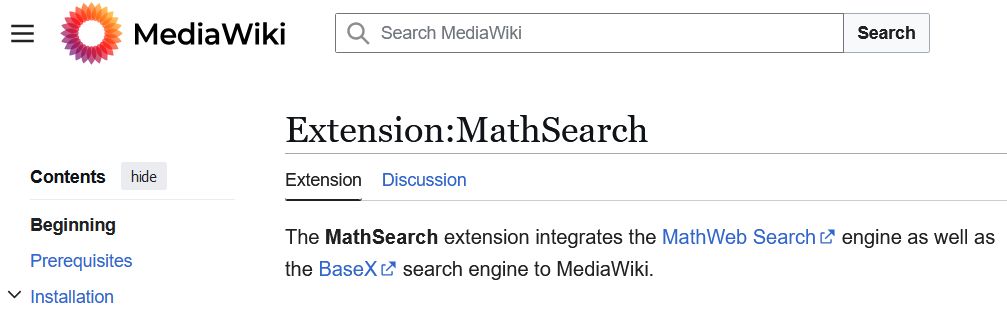 |
MediaWiki Math Search ExtensionTool/Application (No status available.)
The MaRDI portal team adjusted the extension for semantic formula search in the knowledge graph. The extension is used by several wikis dealing with mathematical formulae. Maintained by: TA5
|
 |
MaRDI Packaging SystemTool/Application (beta version)
MaRDI Packaging System: Simplifying Software PackagingMaPS, short for MaRDI Packaging System is the working name for the software system created by TA1 Computer Algebra for Measure 1.4 Predefined software environments. MaPS provides a unified interface both, to package a software inside a functional environment (called a runtime), and to install a published runtime onto a computer system in a user friendly way. A publication describing this tool can be found at https://link.springer.com/chapter/10.1007/978-3-031-64529-7_26 . How does it work?MaPS deploys packages including their complete library dependencies in an environment which does not conflict with other packages installed on your computer. Deploying runtimes is a one line command. Packaging a runtime is only a small overhead. More information is available at the MaPS wiki.Maintained by: TA1
|
 |
MaRDI Knowledge GraphDatabase (stable version)
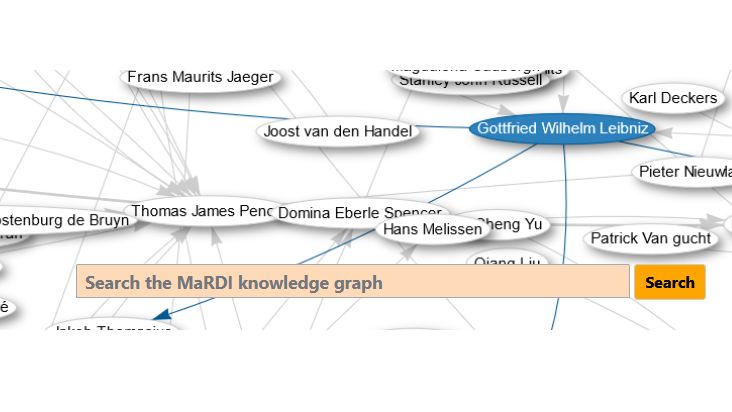
The MaRDI Knowledge Graph: A New Way to Explore Mathematical ResearchServing the global mathematical community, the MaRDI Knowledge Graph is a growing resource that brings together over 5 million items and 500 million relationships from various open mathematical research data sources. It integrates information from repositories such as DLMF, CRAN, PolyDB, swMATH, zbMATH Open, arXiv, and OpenML, creating connections between datasets, publications, software, and mathematical concepts. What does it do?The MaRDI Knowledge Graph helps organize and link mathematical research data, offering structured insights into how different resources relate to one another. It enables researchers and students to navigate across datasets, software tools, and research papers, making it easier to explore connections between different areas of mathematical research and applications. How can it be used?
Maintained by: TA5
|
 |
MaRDMOTool/Application (stable version)
MaRDMO: Future Gateway to FAIR Mathematical DataMaRDMO is an extension of the Research Data Management Organiser (RDMO) designed to facilitate the documentation, integration, and sharing of mathematical models, interdisciplinary workflows, and soon algorithms. As a user-friendly interface, it connects researchers with MaRDI services such as the MaRDI, MathModDB and MathAlgoDB knowledge graphs, while also integrating external data sources like Wikidata. By streamlining research data management through guided interviews and encouraging the reuse of existing information, MaRDMO enhances transparency, reproducibility, and interoperability across disciplines. Researchers can document, search, and share mathematical research data seamlessly, ensuring broad accessibility and usability within the scientific community. How to use it?The MaRDMO Plugin and its corresponding question catalog are available on GitHub and can be integrated into any existing RDMO instance, whether local, project-specific, or institute-wide. In the near future, MaRDMO will be accessible to all researchers through MaRDI's RDMO instance, provided by the basic service DMP4NFDI. A test instance with limited functionality (no export to MaRDI services) is currently available here. To document an interdisciplinary workflow or mathematical model—or to search for existing ones—users complete a guided interview in MaRDMO. Once all questions are answered, the documentation can be published to the relevant MaRDI service with a single click. If the search option is selected, MaRDMO suggests suitable interdisciplinary workflows based on the user's input.Maintained by: TA4
|
 |
MaRDI Help DeskOutreach | Support/Consulting (stable version)
The MaRDI Help Desk is your first entry point to MaRDI services, support, and training. Mathematical data consultant Christiane Görgen can help you find out how to handle your research data in practice, what to write in a funding application about it, or how to connect to existing infrastructure and projects. She currently prepares training material for these topics, knows the consortium inside out, and can direct very topic-specific inquiries to the appropriate experts. Dissemination coordinator Tabea Bacher supports the initiative's outreach, community integration, and workshop implementation. She can help with organizational matters, and she is busy building bridges between MaRDI and the library communities. Maintained by: TA6
|
 |
MaRDI Open InterfacesTool/Application (beta version)
Software that connects different numerical packages together. Users can invoke numerical solvers written in one programming language from another one. Besides that, implementations for the same numerical problem are accessed via a generic interface to avoid code modifications when switching implementations. Maintained by: TA2
|
 |
mlr3Tool/Application (stable version)
mlr3 is an open-source machine learning framework in R that provides a unified interface for training, evaluating, and benchmarking machine learning models with extensible support for various algorithms and workflows. Maintained by: TA3
|
 |
MathAlgoDB Knowledge Graph for Scientific ComputingTool/Application (stable version)
Algorithms are the main building blocks of scientific computing. MathAlgoDB is a knowledge graph with an underlying ontology that allows to systematically search algorithms solving problems, publications documenting them, software implementing and benchmarks testing them. The knowledge graph is accessible via a user-friendly interface that allows adding and editing available data. Maintained by: TA2
|
 |
MaRDIFlowTool/Application (beta version)
Design and Description of FAIR CSE WorkflowsThis computational framework abstracts multi-layered components from FAIR computational experiments through an input/output pipeline. By incorporating them into redundant descriptions, we describe arbitrary levels of abstraction ranging from mere I/O data to mathematical models. A recent publication describing the tool can be found at https://arxiv.org/abs/2405.00028 Key FeaturesComprehensive Workflow Framework: Enables the abstraction of computational components to describe FAIR workflows. Multi-Layered Component Support: Ensures the integration of various layers such as numerical methods, mathematical models, and I/O data. Output Formats: Supports HTML, PDF, and Jupyter Notebook outputs for enforced documentation and reporting. How can it be used?Using this working prototype (two use-cases), users can execute the workflow through a user-friendly command-line interface, enabling interaction with the framework's features.Maintained by: TA2
|
 |
MathModDBDatabase (stable version)
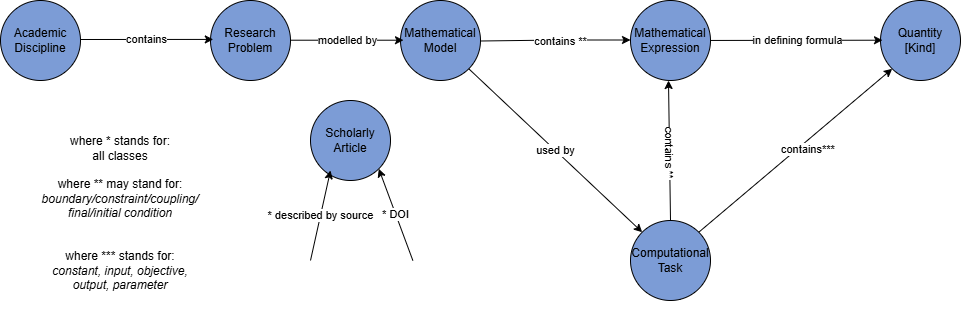
MathModDB: A database for Mathematical ModelsMathModDB defines a data model with classes (Mathematical Model, Mathematical Expression, Academic Discipline, Research Problem, Quantity (Kind), Computational Task, Scholarly Article), object properties/relations, data properties and annotation properties as an ontology. This ontology is populated with individuals/data from various fields of applied mathematics, making it a knowledge graph. What does it do?The MathModDB Knowledge Graph helps organize and link mathematical models, offering structured insights into mathematical modelling and related computational tasks. It enables researchers and students to navigate across mathematical models and expressions, as well as scholarly articles, making it easier to explore connections between research problems from different academic disciplines. How can it be used?
Maintained by: TA4
|
 |
mrdi File FormatTool/Application (stable version)
The mrdi File FormatDue to the nature of data in computer algebra, the storage of such data requires a more sophisticated format. The mrdi file format is a JSON based file format with the necessary structure for saving and loading common types among computer algebra software. A publication describing our file format can be found here. UsabilityWe have written our proof of concept implementation using the Oscar.jl. computer algebra system. There is also an implementation for some of the types available in the Magma computer algebra system here. We are also working on an implementation for the Macaulay2 and Sage computer algebra systems.Maintained by: TA1
|
 |
Community - Graphical Modelling and Causal InferenceCurated Collection (stable version)
The Dataset collection on Graphical Modelling and Causal InferenceWe host the Zenodo community Graphical Modelling and Causal Inference. On this platform, we curate and present topical datasets, dataset collections, and metadata. Exemplary statistical notebooks showcase advances in methodology and present new applications. The community supports content moderation by TA3, and we will encourage and solicit submissions of datasets and notebooks by researchers from the broader academic community. What does it provide?
How to use it?
Maintained by: TA3
|
 |
MaRDI StationOutreach | Tool/Application (stable version)
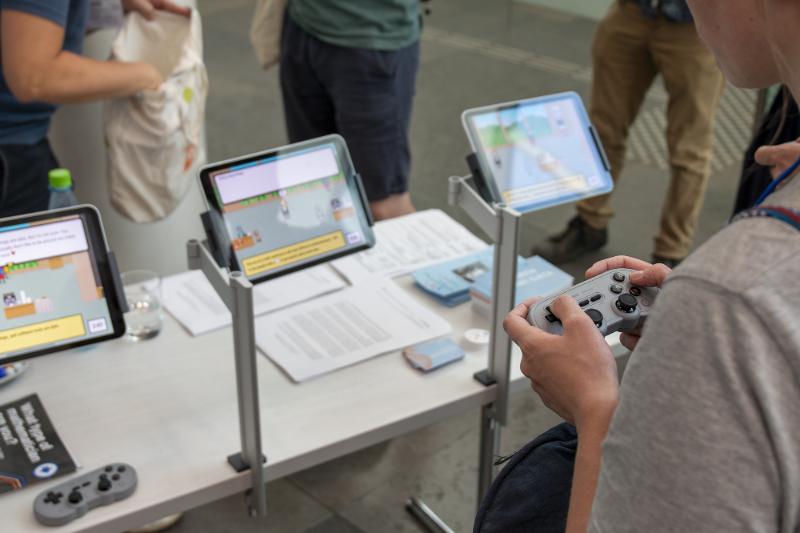
The MaRDI station offers an educational, gamified approach to research data management. It comes in three versions. There are two multiplayer versions: a portable one, consisting of three notepads and a projector, and a version with exhibition furniture, consisting of three consoles installed on a desk alongside a projector. In both multiplayer versions, the MaRDI station includes one of the following open-source games: A game designed for the general public about freedom of data or a game for mathematicians of all kinds, exploring research data topics in a university campus setting. The third version is a single-player adventure game, also dealing with research data topics. Get a sneak peek here. The latter is ideal for mathematicians seeking to familiarize themselves with research data topics. If you want to rent and showcase the MaRDI station at your workshop, conference, or event, you can contact us via station@mardi4nfdi.de. Since the game engine is open source, you may also create your own adventure with stories of any topic you like, and set in a world of your choice. Maintained by: TA6
|
 |
Best PracticesSupport/Consulting (stable version)
MaRDI offers support and consultancy for making your own mathematics FAIR. One example is the project "small phylogenetic trees": an early 2000's mathematical library transformed into a modern website, a software package, and a best practice report. Another example is the FAIRified mathematical research-data repository MathRepo. Maintained by: TA6
|
 |
MaRDI Knowledge Graph Query ServiceWeb application | Tool/Application (stable version)
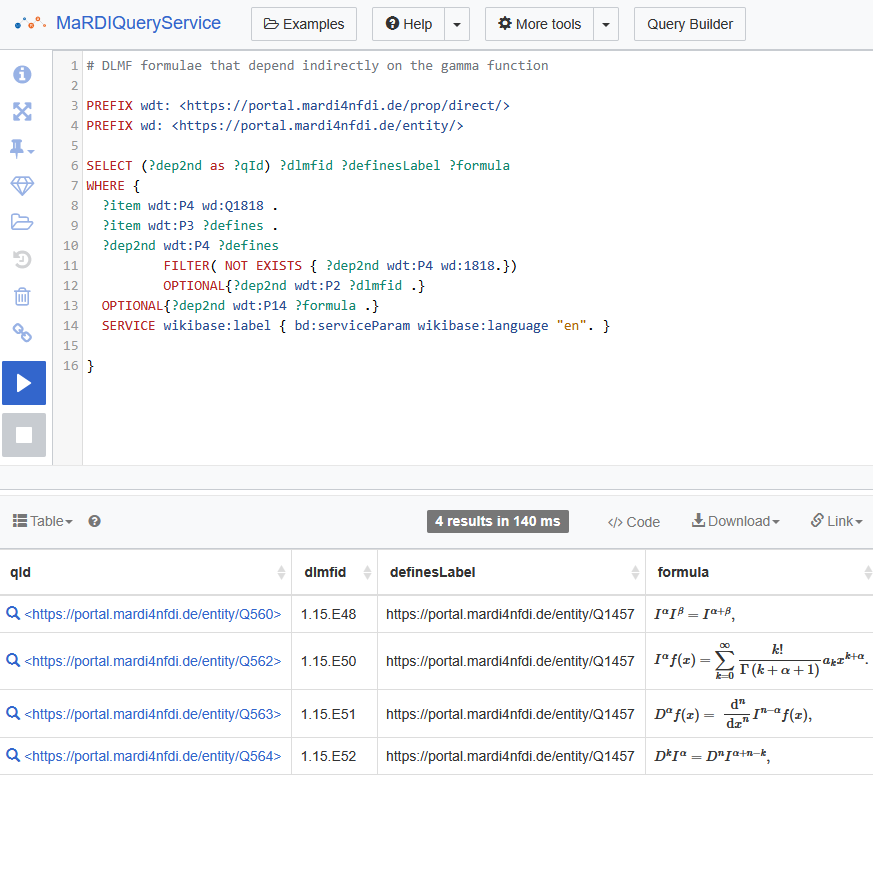
The MaRDI Knowledge Graph Query Service is a webservice that allows to query the MaRDI Knowledge Graph using SPARQL. For instance, it can be queried for DLMF formulas that depend indirectly on the gamma function. Maintained by: TA5
|
